
A reintroduction to Pilates Native: Who we are and what we do
Hi there, what’s up, what’s going on, how are you?
Somehow it’s already mid-September. My kiddo started 7th grade, the front yard grass removal and pollinator garden is (finally) finished, the studio’s painted, and I managed to majorly botch a logo decal install. 😅 After a whirlwind summer of trails, dirty finger nails and back-to-school chaos, September feels like a great place to land, take a breath and reset.
With new folks joining us in the studio and regulars finding their groove again, now feels like the perfect time to reintroduce ourselves.
So hey, hi! Welcome to Pilates Native. I’m so glad you’re here.
🌿 What We’re About
Pilates Native is all about making movement work for your body. We specialize in helping people with injuries, hypermobility and hEDS, prenatal and postnatal needs, athletes, and anyone who wants to move with more strength and less pain.
Our sessions focus on learning how your body works, building core strength, and creating movement patterns you can use in real life. Whether you’re training for the trails, bouncing back after pregnancy, managing an injury, or just tired of waking up achy, we’ve got you covered.
We are also deeply committed to training quality instructors with real world experience.
🤝 Who We Are
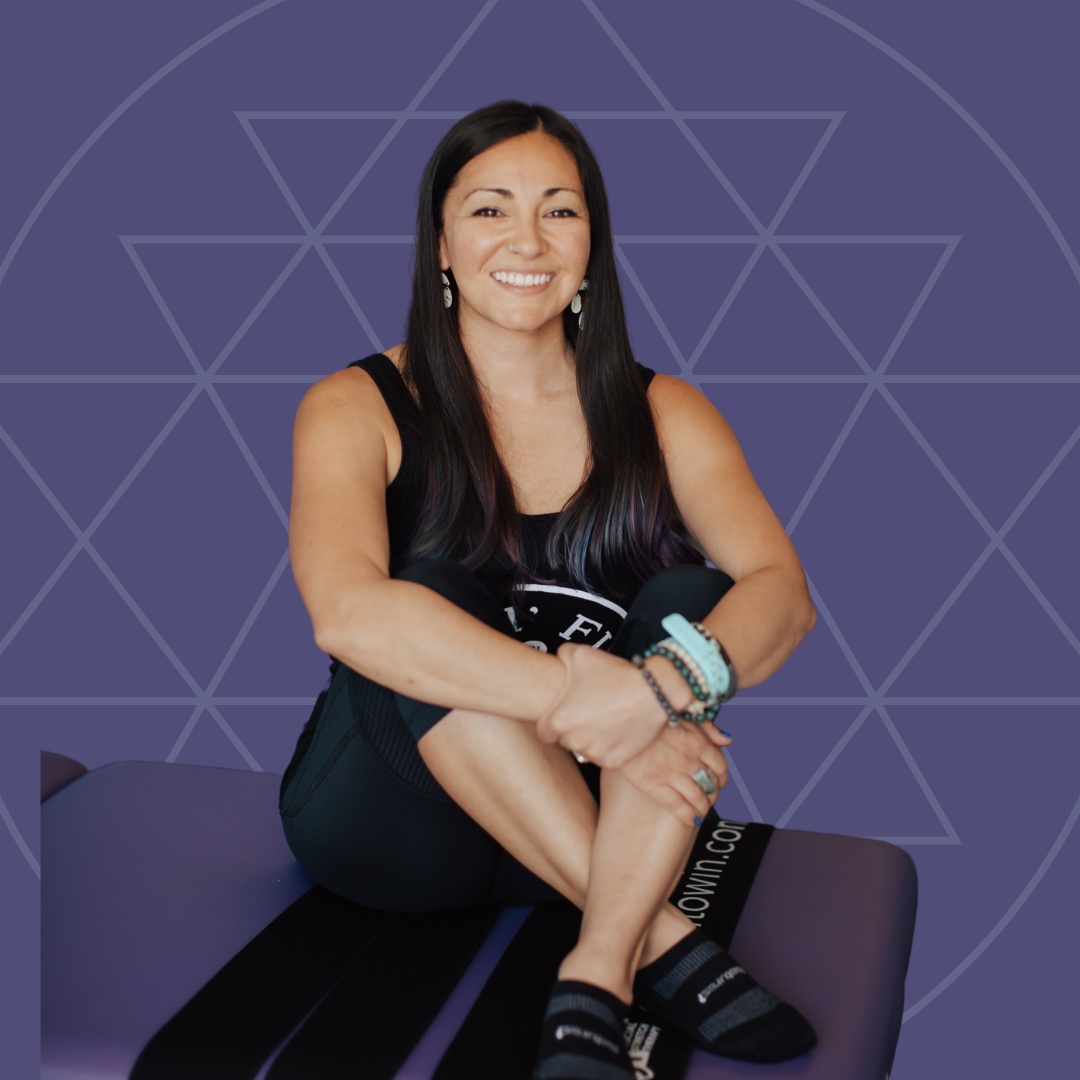
Rubecca – Owner, Pilates Instructor, FST Stretch Therapist
Engineer turned Pilates teacher, studio owner, stretch therapist and forever student of movement. I built Pilates Native to make Pilates more accessible to more people. I spend an incredible amount of time geeking out about the body, movement, sports and brains.
Sessions with me will feel delightfully weird, thoughtful, and peppered with fun science facts. While I probably won’t remember right from left or count properly to 8, I will genuinely care about your progress and recovery.

Laura – Pilates + Thai Yoga/Massage
Originally from Buffalo, Laura brings a strong direct teaching style to the studio. While she’s got an eye for those small details and excels at the foundations, she also brings the heat. Laura will mindfully take you past your comfort zone while keeping it safe and playful. She has a knack for spotting exactly what your body needs and taking you there.
Pilates sessions with Laura feel like a fiery mix of tough love and woo-woo magic. They’re straight forward, challenging and super fun. Laura’s Thai Yoga sessions are an incredibly relaxing blend of stretch, massage and energy work that can’t be matched.

Allison – Our newest instructor
Allison is warm, encouraging, and full of energy. She trained with Pilates Native/Pilates Plus and has started offering sessions at Pilates Native. She’s already developed a reputation for fun, safe sessions that help clients feel confident in their Pilates practice.
Sessions with Allison feel like moving with your best cheerleader at your side. These sessions are fun, encouraging, and confidence-boosting from start to finish.
Isabella – Virtual Assistant
Isabella first joined Pilates Native as a student client, then an intern and now supports the studio as our virtual assistant. She’s on the path to becoming a professional ballerina and between her ballet trainings and real job in California, Isabella handles all of our booking, creates graphics, and helps keeps things organized behind the scenes.
She is one of the few people who can read Rubecca’s handwriting, meaning she will probably have to stay on the team forever.
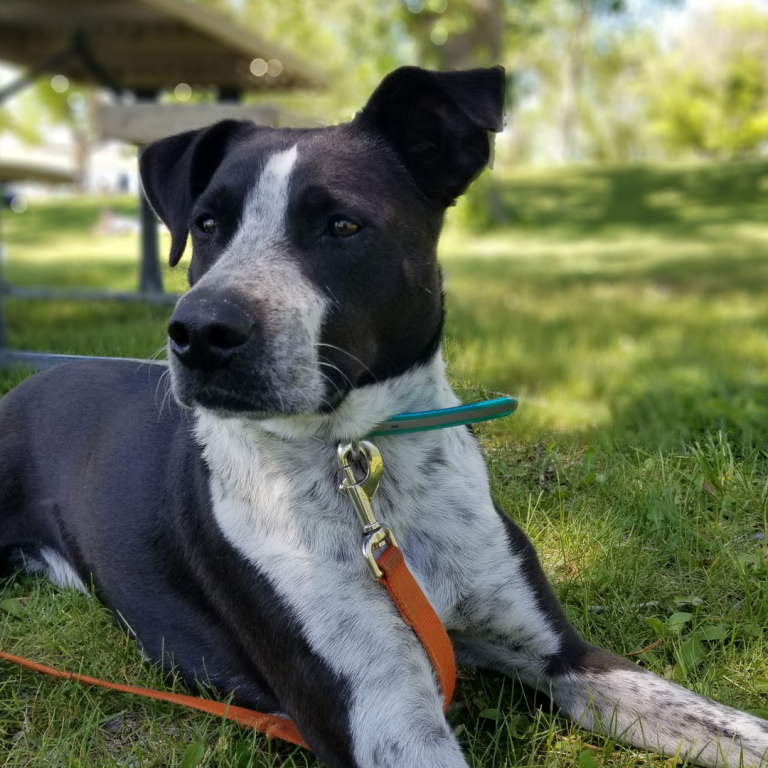
Roscoe – El Jefe
The real boss of the studio and our four-legged mascot.
Roscoe is great at greeting clients, warming up mats, providing balance challenges and occasionally supervises classes between naps.
🪷 What We Offer
Here’s a quick list of everything you’ll find at our studio:
Private Pilates sessions – one-on-one support, fully tailored to your goals.
Duets – train with a friend, partner, or family member. These two-person sessions give you the personal attention of privates with the fun and motivation of working alongside someone you know.
Small-group equipment classes – blends of reformer, tower, chair, and mat with no more than 3-4 folks per class.
FST Stretch Therapy + Thai Yoga Massage – assisted stretching that helps you release tension and move with more ease.
Special Pop-Ups & Community Classes – monthly themed sessions and events that keep things fresh and fun.
Special Populations Expertise – we work with athletes, hypermobile/hEDS clients, prenatal & postnatal parents, men, and student athletes. Sessions are available in-studio or over Zoom.
Comprehensive Pilates Instructor Training – A 450-hour comprehensive program for those who want to go deeper, whether your goal is to teach or just to understand Pilates on a whole new level. We’re proud to train the next generation of knowledgeable, detail-oriented instructors.
🌟 What Makes Us Different
There are plenty of places to do Pilates, enjoy Stretch Therapy, or enroll in Pilates Teacher Training. Here’s what sets us apart:
Engineer’s Eye for Detail – I’m not just a Pilates instructor; I’m also a Mechanical Engineer with 15 years of QA/QC experience. That background means I notice the small details: alignment, breath, muscle engagement. Those refinements are what transform a good session into a game-changing one.
Equipment for Every Body – Our reformers, towers, and chairs are adaptable for a wide range of bodies, heights, and abilities. We make sure the equipment works for you, not the other way around.
Small + Personal –Whether it’s group class or Instructor Training, we keep things intentionally small so you get real attention and support while also enjoying being a part of a small community.
Specialized Knowledge – From athletes to prenatal/postnatal clients, to hypermobility and hEDS, we have the training and experience to help you move safely and effectively.
Stretch + Strength – We don’t just build core strength. We balance strength with recovery through stretch therapy, Thai yoga massage, and mindful movement.
Trauma-Informed Studio – We honor that every body carries its own story. Our instructors are mindful, respectful, and committed to creating a safe, supportive environment for movement.
Clear + Upfront Pricing & Policies – No hidden fees, confusing memberships, or fine print. We’re transparent about what things cost and how we operate, so you always know what to expect.
Instructor Training That Sets the Bar – Our program is rigorous, detail-focused, and built on real-world application. Every teacher we mentor learns how to work with diverse bodies, injuries, and special populations. Our program utilizes real clients as demo students and tuition is all inclusive. Everything needed to certify is covered.
🌟 Why We Do It
Every instructor on our team came to Pilates because of injury or chronic pain. We know what it’s like to be in pain, to feel limited, and to be told what our bodies can and can’t do. Pilates gave each of us a way to rebuild and gave us a safe place to move when everything else felt impossible, scary or too hard. For each of us, Pilates has been the key that lets us keep lifting, running, hiking, dancing, doing yoga, and all of our other fun hobbies.
Whether you’re recovering, training, or just trying to feel less achy, we’ve been there, and we know how helpful Pilates and Stretch can be.
🍂 Come Hang Out
If you’ve been Pilates or Stretch curious or you’ve taken a break and want to get back to it, September’s a great time to jump in and try class, book a stretch, or just pop in and say hi. If you’re interested in Instructor Training, let’s chat! We have opportunities to start training in October or January.
Looking forward to seeing you in the studio soon!
-Rubecca
Pilates 101: The Infamous Origin Story
If you have no idea what Pilates is, or even how to describe it to others, you’re in good company. Most people have never heard of Pilates, have only heard of it in relation to super hot rich celebrities, or confuse it with yoga.
If you know a little about Pilates, you may be familiar with sleek studios, strange equipment and depending on your age, Pilates may draw up visuals of Jane Fonda workout videos or youtube Pilates.
What you might not know, is that Pilates was originally called Contrology and was invented by a chain smoking, cigar loving, former assistant brewer and boxer with a flair for tall tales.
What we know now as “Pilates” is named after the man who invented it, Joseph Pilates.
In many ways, Joe was larger than life and the stories about him and the history of Pilates are made for Hollywood. Common myth has Joe as a weak sickly child who suffered from asthma, rickets and a whole host of maladies. Tired of being a sick weakling, Joe took matters into his own hands and began to study anatomy, gymnastics, boxing, yoga, body building and martial arts. His father actually owned a boxing gym, making this pursuit a little easier on the young Joe.
Story tells that Joe transformed his body into such a strapping specimen that he was utilized as a model for anatomy books. Looking at photos of Joe throughout his life, it’s easy to believe. Well up into his 80’s, he was extremely fit and muscular, and often wearing what could only be described as a fitness version of “tighty whities”.
The story takes a gritty turn in the early 1900’s. Allegedly, Joe was living in England and teaching self defense for Scotland yard, while also working as a circus performer and a professional boxer. When England entered WWI, they rounded up all foreign nationals living in England at the time and thus, Joe, a German citizen, was interned at the Isle of Man. It was apparently during this time without much else to do, that he began to develop “Contrology”. The frequently repeated (and probably false) Pilates origin story claims that he utilized the springs from the hospital beds as resistance trainers and that’s how the Reformer and Cadillac were born.
After the war, Joe returned to Germany for a short time before abandoning a second family and heading off to New York City where he opened up his first Contrology Studio with his third wife (and possibly just life partner), Clara.
Due to the studio’s proximity to the New York City ballet and Joe’s reputation for helping injured dancers extend their career, Pilates became a mainstay in the dance community.
Joe spent the rest of his life chain smoking, teaching his method, inventing equipment, giving wild interviews and sending friends Christmas Cards with photos of himself wearing tighty whiteys.
When Joe died, Clara struggled to keep the business running and the entire method was at risk of being lost forever. Two of Joe’s former students stepped in to keep the Pilates Method going, leading into the branching of Pilates into the Classical and Contemporary methods, a long drawn out court battle over trademarks and who owned Pilates, before the eventual explosion of Pilates as we know it. (See, Hollywood is written all over this story.)
Now a days, Pilates still attracts dancers, athletes and celebrities, as well everyday people who want to move better, recover from injuries, and improve posture.
My Unexpected Introduction to Pilates
In my early 20s, I came home for a visit and went for a trail run. Mid-run, a lightning storm rolled in, and I was hauling ass down the trail when I slipped, fell and took a very painful tumble down three switchbacks. I chipped my teeth, scraped up my arms and legs, and jammed my femur into my hip socket. I was in severe pain and limping for weeks from that fall, which led to countless chiropractor appointments and an eventual referral to try Pilates.
At the time, I didn’t even know what Pilates was. I walked into a mat class at the gym thinking, “How hard can it be?”. I was running 40 mile weeks, lifting daily, doing yoga multiple times a week, and cycling up to 70 miles every Saturday.
Five minutes into class, I was panting, sweating and my legs were trembling uncontrollably. After struggling to do a single rollup, I looked around, and saw the room was full of sweet little old ladies absolutely crushing it. By the end of that class, I was toast. I actually waited until everyone else left before very ungracefully lumbering off of the mat and staggering out of the room.
I was hooked.
Why Pilates Works
Joseph Pilates was incredibly adept at anatomy and spent a lot of time studying different movement practices and observing animals. Pilates utilizes all of the planes of movement and at its core (pun intended!) it is about intentional, holistic, mindful movement. Every exercise emphasizes:
Core strength not just abs, but the deep stabilizing muscles
Alignment maintaining optimal posture and position during movement
Breath breathing patterns in Pilates support movement and release tension
Control & precision Pilates emphasizes controlled precise quality of movement over loads of wild ranges and qualities
This blend of strength, mobility, and mindfulness makes Pilates a powerhouse exercise method, whether you’re recovering from injury, cross-training for sports, or just hoping to move with more ease.
Ready to start your own Pilates story?
Luckily, you don’t have to fall off of a mountain to start your own Pilates journey. But if you did, we’ve got you covered.
In addition to our private one-on-one sessions, we have multiple small group classes and some special series kicking off.
I can’t wait to see you in the studio!
-Rubecca
What do Pilates and Toothbrushing Have in Common?
I started my Pilates career as a Sports Therapist for Spine & Sports Therapy in Houston. Our five person team specialized in high endurance and high intensity athletes. Ironmen, marathon runners, ultrarunners and extreme athletes were our bread and butter. As a new instructor, I was constantly amazed by the intensity of the training programs our clients followed. They’d wake up at three in the morning for three hour runs, head home to get themselves and their kiddos ready for the day, work a full day, take care of parenting duties, make dinner, help with homework, put the kids to bed and then head out for 2-3 more hours of training. Their weekends were spent training around soccer schedules, dance performances and grocery shopping.
The craziest thing was how much time, money and effort these folks spent on managing their injuries.
They had biweekly standing appointments with the chiros and due to the nature of our program setup, they were forced to attend 1-2 appointments per week with me for Corrective Exercise and Stretch Therapy.
A large portion of my job included movement reeducation and a deep dive into the ergonomics of everything. From gait training, shoe selection and posture to sleep habits, desk setup, and driving habits, we covered the gauntlet of non-exercise habits that could be contributing to their issues. It was common for clients to lug bags full of shoes, pillows and other accessories to be tested, fitted and trained on.
We also spent a lot of time on the absolute very basic foundational things. Standing posture, breathing, core engagement and standing balance chief among them. It wasn’t uncommon to have clients with extreme debilitating back pain who could run competitive marathons, but were incapable of standing up straight or being able to balance on one foot for more than 5 seconds.
I can’t tell you the number of Ironmen I worked with who paid big bucks for specialized bootcamps but still couldn’t do a single *proper* pushup or sit-up.
They could do 1000 shitty form pushups and 1000 neck strainer sit-ups, but they would struggle, tremble, sweat and glare at me when they had to do one proper set. It wasn’t uncommon to see one of these amazing endurance athletes resembling an upside down turtle as they struggled to engage their core and lift their head, neck and shoulders up without kicking through their legs or bumping their bum into the floor to utilize momentum to get them back up.
Working 40-hour weeks with these clients taught me one key lesson. The importance of what I now call the “toothbrushing work”.
Think about it. Tooth brushing is the smallest most benign habit we have. Low skill, low attention required. Minimal time commitment of twice a day, two minutes a day. Add another minute or so for mouthwash and floss. We’re in and out in under 5 minutes a day for this ridiculously small habit.
Despite it’s minimal nature, we all know skipping tooth brush time it isn’t an option. Without this small, regular habit, bigger problems start to build. In addition to yucky mouth feel and bad breath, routinely skipping tooth brushing leads to tooth decay, gum disease, infections, and an increased risk of heart disease, stroke and even dementia! Brushing our teeth isn’t just about aesthetics. It’s about preventing systemic health issues that can affect the entire body.
Core strength, balance, proprioception, and mobility are the toothbrushing of our movement practice.
Those Ironmen weren’t getting injured just because of their insane training plans. They were getting injured because they weren’t doing the movement equivalent of brushing their teeth. They weren’t doing the foundational basics that kept their bodies resilient and functional.
When we neglect these foundational elements of movement, we might find we have poor posture, weak core muscles, bad balance, and lack of mobility. For some folks, those things can translate into chronic neck, shoulder, hip, and back pain, fall risk, increased injuries, sprains, strains, tears, fractures, joint stiffness and trouble moving with ease. Not to mention the constant fatigue and wear and tear that accompanies poor mechanics.
Just like skipping tooth brushing can lead to major problems, ignoring the daily foundational movement basics can severely impact your health and quality of life.
Here’s the good news.
Just like toothbrushing is a total low level activity with a big bang, your foundational basics don’t have to be hard or fancy. They don’t need to be intense or take forever. They just needs to be consistent. 4 minutes a day is 1,460 minutes a year, which adds up to about 24 hours and 20 mins. That’s a whole lot of investment for a little work each day.
If you’re looking for that quick extremely foundational and basic routine, here’s what we taught at the clinic and asked clients to do. You’ll recognize the daily routine as your Pilates homework. 15 years later, I’m still using this work, because it’s so effective.
Daily:
3-D Breathing x 1 minute
Single Leg Standing Balance 2 x 1 min each leg
Total time: 5 mins
3x/week:
Therapy Bridges (aka neutral bridges or Pilates bridges) 2 x 1 min
Side laying double leg lifts 2 x 1 min each side or Elbow/Knee side planks 2 x 1 min each side
Table Top 2 x 1 min or Elbow/Knee planks 2 x 1 min
Total time: 8 mins
Your subconscious can’t tell time, so if the 1 min time frame is too much starting out, break it down into smaller pieces and start to build your way up.
ie Start with six 10 second holds, work towards four 15 sec holds, progress to three 20 sec holds, to two 30 second holds, one 45 sec hold + one 15 sec hold, work up to one 60 sec hold.
In the same way we don’t just start brushing our teeth when we feel a cavity forming, we also don’t want to wait for aches, pains, or injuries to start moving.
Movement is medicine. And it’s essential preventative maintenance.
Think of Pilates as the toothbrush for your posture, your core, your balance, and your mobility.
Until next time,
-Rubecca
The Pilates Native Client Journey
Posted on August 24, 2024 by pilatesnative
So what exactly am I doing here?
A few years ago, a client walked in and said “So what exactly am I doing here?” That was such a great question! We pulled out the Initial Assessment and discussed where they’d been at the time of IA and where they were currently. I am so grateful for the client that asked this super important question. It made me realize that while I’ve been really good about communicating the reason for the Initial Assessments and how they guide sessions, I’ve been really bad about sharing the bigger long term picture.
This prompted me to finally take all of the things that are in my brain and set them down on paper. So without further ado, I introduce you to “The Pilates Native Client Journey”.
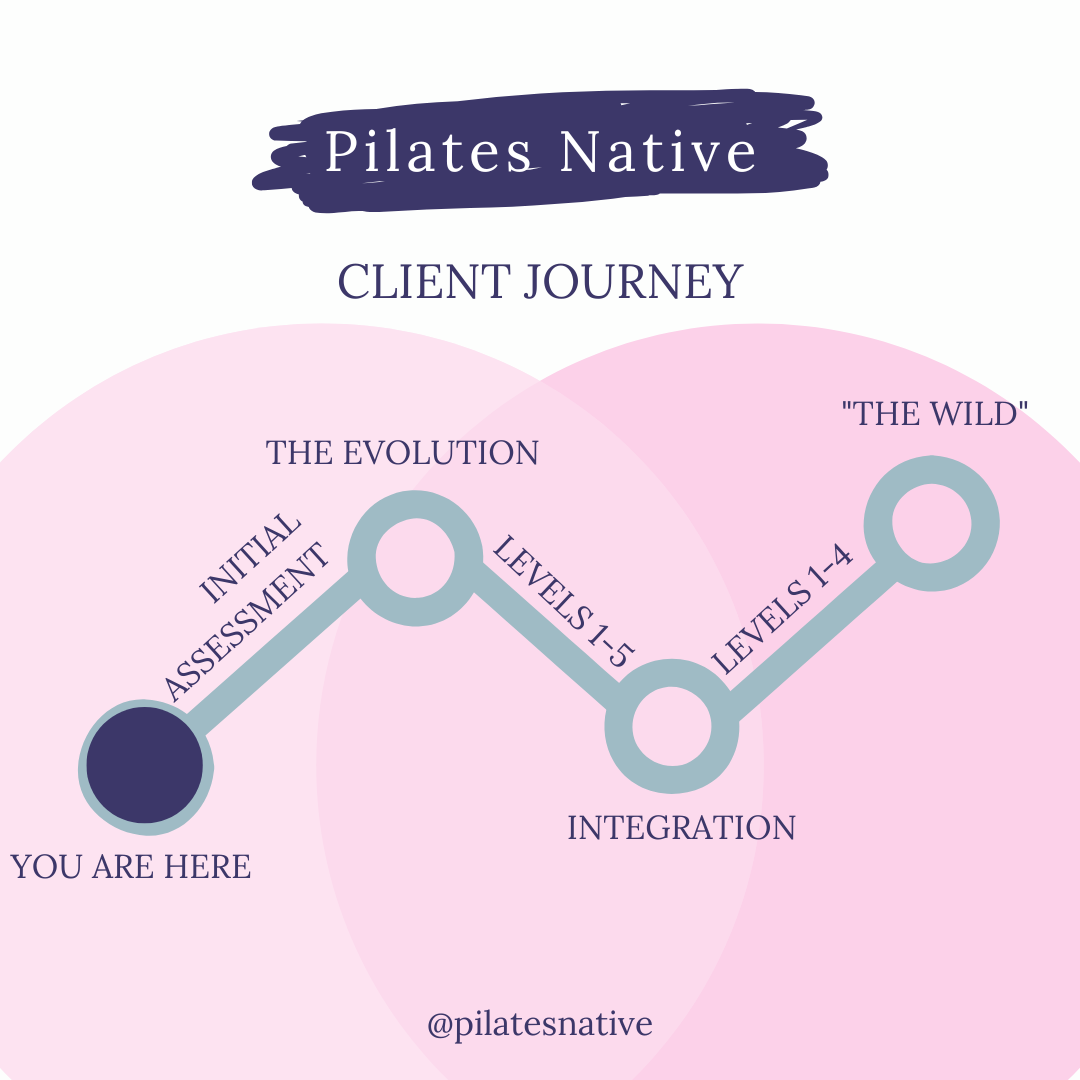
You are Here
Pilates Native specializes in athletes and sports injuries. The majority of our clients identify with most or all of the description shown in the “You are Here” graphic. The aches, pains and irritation are what prompt folks to schedule their Initial Assessment (IA) with Pilates Native.
The Initial Assessment tells us where the body is in terms of balance, proprioception, core strength and functional mobility. Then, based on the results of the IA, we determine which program will work best for you: The Recovery Lab, The Balance Equation or the Stretch Equation.
The 1st two landmarks on the Client Journey map may be pretty familiar, as most of you have done your assessment and chosen a program. But what you’re not familiar with and what I’ve finally locked down onto paper, is the overall plan behind those assessments and programs and where we’re going with all of this!
The Evolution
There are 3 stages at Pilates Native: The Evolution, Integration and “The Wild”.
The first stage, called “The Evolution” focuses on really building and repairing the foundation of movement. This is where we focus on balance, proprioception, stability, core strength, and functional mobility. We know that these five foundational components are crucial to pain-free activity.
This stage includes The Recovery Lab, The Balance Equation and The Stretch Equation.
Why is it called “The Evolution”? Because we are evolving away from the mindset that movement and exercise is just for weight loss or ass kickin’ and can actually be used to heal the body. The Evolution has 5 levels, each with an increasing degree of balance, proprioception, core strength, stability, and functional mobility required.
Integration
Graduates of The Evolution move to Integration. Comprised of 4 levels, Integration is designed to build up the skills developed during The Evolution with the added challenge of integrating dynamic movement and endurance to the movement practice. Adding dynamic movement and endurance to our practice enables us to train in a way that supports positive muscle memory and promotes injury prevention.
This stage includes Integration and The Stretch Equation.
Why is it called “Integration”? Because we are actively integrating the tools learned in The Evolution with dynamic movement, endurance, and our specific daily life needs.
You may find yourself accidentally adding Pilates exercises to your workout routines, breathing deeply at the grocery store, or otherwise integrating what you’ve learned into daily life.
“The Wild”
And finally, The Wild! Graduates of Integration move into “The Wild” which is an advanced Pilates practice that explores and pushes the edges of what the body can do in an optimized state of mind + body connection and a functional balance between strength and mobility.
This stage includes Advanced Pilates and The Stretch Equation.
How long does this all take?
Where you are and how long it takes you to move through each level and each stage depends on you, your goals and your current abilities. There is no set timeline for these levels or stages, as each of us is different and may need more or less time to work through the program. Some of us may be fine staying in The Evolution or hanging out in Integration, and that’s totally ok! My goal as an Instructor is to get all of my clients through Integration. This is where you’re really thriving and able to perform your normal daily activities within the full range of functional movement.
You may have noticed that The Stretch Equation is included in each level. That’s because we want to support our mobility and nervous system needs at each stage. We also know that certain sports and activities create specific muscle patterns. Pairing stretch therapy with our Pilates practice allows us to maintain our functional balance between strength and mobility.
If it’s been 6 months or more since you’ve done your Initial Assessment, let’s check back in and see where you’re at now. We really want to use those assessments to guide your practice and make sure we’re focused where you need it most.
If you’ve never been in before and would like to get started, we’d love to have you! Come on in and let’s see what we can do.
The Method Behind the Madness…part 4
Posted on March 5, 2022 by pilatesnative
Unlocking the Body
I tend to think of the body as a puzzle or a video game. With our Pilates practice, we’re unlocking levels as we go. If we don’t successfully unlock level 1, we can’t fully access level 2.
Unlocking the Body with Muscle Memory
If your IA or previous exercises have shown that you currently do not have the ability currently to access or understand movement related to the ribcage, I’m not going to cue you during footwork or bridges or whatever else to “close the ribcage”.
If I cue you to “close the rib cage” and you have absolutely no idea how to execute that cue, or how to even connect to the part of the body that moves the ribcage, that’s a wasted cue. Instead of guiding you to a connection and a deeper understanding or communication with your body, we’ve guided you towards uncertainty, frustration, or self-consciousness. Or you’ve completely ignored the cue and it’s meaningless anyway.
However, if I observed you naturally closing the ribcage during certain movements in the IA or during other Pilates exercises, we can use those exercises to help develop further understanding of “closing the ribcage”.
The first thing we do is develop muscle memory by repetition. We utilize the exercises you can properly execute to develop really strong muscle memory. We do them over and over and over. When both the brain and the body understand the movement, then we can start cueing that movement in other exercises.
Unlocking the Body with Exploration
Secondly, we may need to address stability, mobility, strength or brain connection before we can access certain movements. This is where things can get tricky.
We may find we need to develop all four to execute an exercise. In that case, we need to prioritize. Do we need to focus most on stability? Strength? Mobility? Brain connection? And how do we best do that?
After addressing form and safety, I tend to lean towards brain connection first. Humans are kinetic learners. We learn by doing. Sometimes we need to explore a movement and just roll with it until we understand how that movement works.
Once we get the basic mechanics of how a movement operates, we can start focusing on stability, strength and mobility.
Frequently, as clients explore different exercises, they themselves find the “missing piece” and are able to identify what’s needed to properly execute a movement.
I’ve found that it’s best to wait a breath or two before cueing or allow a client to fully explore a movement until they verbalize a question or an understanding.
Allowing exploration of movement, without external cues from an instructor, gives clients a chance to unlock the body themselves. This is what creates understanding between brain+body and gets those neural connections firing.
See you in the studio soon!
-Rubecca
The Method Behind the Madness…part 3
Posted on February 21, 2022 by pilatesnative
Cueing for Maximum Impact
People always ask how a self proclaimed “ambivert” manages to run a Pilates studio and teach 20-25 hours a week.
One of my favorite ways to exist in this space as an ambivert while also prioritizing client needs, is to utilize mindful cueing. What this means, is that instead of a constant stream of cues, I am very mindful and aware of how and when I’m cueing clients.
Enhancing the Mind+Body Connection
We talk a lot about proprioception and the mind+body connection in Pilates. As a Pilates instructor, my job is to help guide you into deeper connection and help you develop those neural pathways between your body and your brain.
Every Pilates Native client starts their journey with an Initial Assessment. During this assessment, I learn a lot about your body and how it works. Each exercise is chosen because it allows me to assess specific movement patterns and reveals imbalances, compensations, dominant patterns and how you engage your brain to move the body. During the assessment, I learn whether or not you can actively engage muscle groups or control your body during specific movements. I also learn whether or not you have the current functionality, whether it’s stability, strength or mobility, to perform certain movements.
When cueing, I rely on what we found in the Initial Assessment to set cueing priorities.
I’ve found that the best way to cue, is to
1) make sure you’re aligned safely and
2) focus on what you can currently connect to and control in the exercise.
Our first priority is always safety. Prioritizing proper alignment as our first cue ensures you’re engaged in a safe practice that won’t damage the body.
Focusing our second cue on what you can connect to and control, develops confidence and body awareness as you are able to follow and execute the cues.
Being able to connect to a muscle group and execute a cue properly is what helps us develop or strengthen the neural pathways between brain and body.
Cueing with a 2 item priority list creates an environment in which you’re maybe getting 1-2 cues over a course of movements. This is intentional. If you are being assaulted with a constant barrage of words, it’s going to be nearly impossible to connect your brain to your body.
Cueing to Accommodate Individual Anatomy & Ability
Every body’s anatomy is different. Spines, for example, are unique to each individual, with their own unique curvatures. A deeper lumbar curve doesn’t necessarily mean someone is not in neutral spine. Their neutral spine may just have a deeper lordotic curve. Cueing this person to a flat back or a “neutral spine” may actually cause harm or misunderstanding of their own body. Likewise, cueing someone with a naturally flatter spine to exaggerate their curves, would be equally inappropriate.
Frequently, we bump up against an exercise or a position that just isn’t accessible for one reason or another. Depending on your IA results, we may need to spend time developing the strength or mobility needed or we might just need to spend some time building awareness around the movement.
Other times, we may just be built a certain way. As an instructor, I’m always mindful of not cueing what a client cannot currently control anatomically.
Cueing to your current abilities allows us to work in a space where we can slowly open up the stability, mobility, strength or brain space needed to get into other movements.
Developing Stronger Intrinsic Body Awareness
When cueing, an instructor is providing external feedback. If a client becomes dependent on instructor cues and external feedback, they lose the opportunity to trust themselves and develop stronger body awareness.
One of the most powerful aspects of mindful cueing is creating space for you to experience Pilates intrinsically. During your sessions, you should always be given room and time to think, feel and move on your own.
Without external cues to validate every movement, your brain and body have to work harder to connect with one another and you really have to focus to build the body awareness.
We want the work we are doing to become intrinsic to your body, so we (safely) remove as many sources of external feedback as possible.
Trauma Informed Safe Space
Pilates Native is a trauma informed studio. This means the studio space is purposely designed to be a safe space for folks dealing with various forms of trauma.
In addition to the usual culprits we associate with mental, emotional and physical trauma, there can be a lot of trauma involved with everyday activities; injuries, surgeries, child birth, falling, work stress, or returning to exercise after illness.
When done mindfully with intention, Pilates is a type of somatic practice. The repetitive gentle movements can provide a safe space for folks to physically release residual stresses and complete the stress cycle.
Pilates can also provide a safe space to start accessing and reconnecting with the body after trauma.
Being overwhelmed with cues that may or may not be accessible totally inhibits the ability to release somatically. If you’re coming in to the studio wired to the ceiling or stressed to the max, you will not be getting a lot of cues. Your practice will prioritize somatic release. You will be getting a lot of familiar slow repetitive movements and a lot of space to explore and play in your practice.
Similarly, if you are joining the studio as a way to heal from a body trauma, your practice will focus more on creating safe and positive interactions with movement.
Distractions
Some instructors cue every movement from head to toe.
“Take a big strong inhale through the nose, being mindful of the ribcage flair, activating through the core to initiate, doming up through the arches, balanced across the feet, hips and shoulders are stacked, pelvis is neutral, allowing that doming at the foot to come up through the pelvic floor and moving up through the diaphragm, shoulders down away from ears, shoulder blades pulling down towards one another, head up, chin lifted, as we exhale, we extend.”
I HATE this style of cueing, both as a student and as an instructor.
What is the priority in that long list? Which of those cues were safety or form related? Which of those cues was relevant to the listener in the moment? What is the focus? How do we make it through that big long list checklist before exhaling into another long checklist?
Over-cueing sucks because it’s distracting, doesn’t provide a clear priority, disrupts focus and pulls you away from your ability to tune in.
If you need this type of instruction, that’s totally ok. We just won’t be a good fit to work together!
Different Instructors
If you’ve taken other fitness classes or Pilates classes, you know without a doubt that each instructor is different. We all have different styles and while we try to be well rounded, depending on our individual backgrounds, we may be more inclined to watch and cue specific areas more than others.
One of my favorite things about taking a week off is having one of our wonderful team members work with my clients for the week. Having a different instructor with a different eye, a different style and a different focus can really enhance your practice!
Your brain may have to work a little harder to connect with their speech patterns and cueing style. They may describe familiar movements differently, prompting different brain patterns to sprout.
They may have a cue that really resonates with you or puts the final piece into the puzzle, allowing you to unlock another level of movement.
Putting it all together
Cueing is an important part of a Pilates practice. A clear communication pathway between client and instructor is paramount to setting a good foundation. Cueing mindfully allows your instructors to give you cues that matter and add value to your practice, rather than just filling the room with words. Intentionally allowing space for clients to explore and understand the movement on their own terms allows room for growth and true development of body and brain connection.
This wraps up part 3 of “The Method Behind the Madness”, a monthly blog series focused on introducing you to what goes on behind the scenes at Pilates Native. Join me next month for Part 4, where we’ll talk about “Unlocking the Body” with muscle memory and intentional exploration of movement.
Take care and see you soon!
-R
The Method Behind the Madness…part 2
Posted on February 21, 2022 by pilatesnative
Mirror, mirror on the wall…
Normally, when you walk into a gym, yoga or Pilates studio, there is usually one long wall with floor to ceiling mirrors.
There are intentionally no mirrors in direct movement eye-line in my studio.
Developing Stronger Proprioception
The first reason has to do with proprioception, or the body’s awareness of self in space. Proprioception is about 75%-80% visual, meaning we use our vision to tell us where we are, what we’re doing and how close we are to other objects. The other 20%-25% is non-visual.
As a Pilates instructor, I am highly interested in that 20%-25% of non-visual proprioception because that’s where we see the body + brain connection really show up. How well do you perform when you can’t see what you’re doing?
Without mirrors, there is no external feedback to rely on to tell you what you’re doing. You have to think, feel and move on your own. What this means, is that your brain and body have to work harder to connect with one another and you really have to focus and build the body awareness.
This is also why we only teach private sessions. In group classes, it’s very easy to copy your neighbor and mimic what they’re doing and how they’re doing it. The problem is two-fold. One, by watching your neighbor, you’ve lost your brain-body connection and any proprioception work. Two, is that your neighbor’s body moves and responds differently than yours and it’s easy to train yourself into habits that don’t belong to your body. Our instructors do not demo entire classes physically with their own bodies for this same reason.
We want the work we are doing to become intrinsic to your body, so we remove as many sources of external feedback as possible.
Trauma Informed Safe Space
Pilates Native is a trauma informed studio. This means the studio space is purposely designed to be a safe space for folks struggling with various forms of trauma.
Mirrors can be highly triggering for people who are actively engaged in or are recovering from eating disorders, body dysmorphia, gender dysmorphia or negative self image.
Exercising in front of a mirror can be especially triggering and/or intimidating.
Distractions
The third reason we don’t have any mirrors is because they’re highly distracting. Instead of focusing on our form, posture or connection, we start analyzing what we look like or what we’re wearing. How many times have you gone to the gym and mid-rep noticed that your hair’s a mess or your socks are different colors? Maybe you use the mirrors to covertly copy the person next to you.
We live a very noisy world visually, so the less distractions we have, the better we can help train our focus and give our nervous system time to settle.
By removing mirrors from the studio space, we can focus on developing proprioception without external feedback, provide a safe space to practice and limit our distractions.