
Clarity as Kindness – Updated Studio Policies and FAQ’s
Posted on January 30, 2025 by pilatesnative
Running always brings up some good brain activity and on the last few runs, I’ve been ruminating on “clarity as kindness”. This idea comes from Brene Brown’s Dare to Lead, which can be quickly summarized in the linked article. Today’s newsletter and most of my January admin tasks have leaned heavily into Clarity as Kindness. In addition to the usual insurance policy verifications, tax prep, and website fixes, I’ve spent a lot of time updating our studio policies to ensure they’re clear, consistent and maintain the integrity of the studio and what we offer.
Updated Studio Policies & FAQ’s
In the spirit of Clarity as Kindness, the studio policies and FAQ’s have been updated on our website. This page goes over session length, what to wear, our late policy, cancellations, reschedules, payment, cleaning, memberships, packages, holiday closures, inclement weather and more. If you don’t want to read through the entire page, the biggest updates are listed below:
What to Wear
Zippers, metal pulls, rivets, necklaces, earrings and other metal on clothing can damage the equipment. Please check clothing is clear of these items when coming in for a session.
Packages and Memberships
6-packs expire three months after the purchase date.
10-packs expire six months after the purchase date.
Monthly membership credits rollover, but must be used within 60 days of the cancelled session.
Clients are responsible for using their packages and membership credits prior to expiration date.
Packages and memberships can be paused for medical, personal or work needs. Please let us know asap so we can work with you to pause your sessions.
Cancellations and Reschedules
We do request that clients reschedule sessions rather than cancel. This allows us to spend more time in the studio with you and helps keep your sessions running smoothly.
Packages and Memberships
6-packs expire three months after the purchase date.
10-packs expire six months after the purchase date.
Monthly membership credits rollover, but must be used within 60 days of the cancelled session.
Clients are responsible for using their packages and membership credits prior to expiration date.
Packages and memberships can be paused for medical, personal or work needs. Please let us know asap so we can work with you to pause your sessions.
Cancellations and Reschedules
We do request that clients reschedule sessions rather than cancel. This allows us to spend more time in the studio with you and helps keep your sessions running smoothly.
Junk Miles, Proper Form and Intentional Movement
Posted on January 10, 2025 by pilatesnative
In the running world, there’s a concept experienced runners know well: junk miles.
Junk miles are the miles you rack up when you’re just running to hit a number of miles in your training log. Unlike intentional training miles, the ones your run purposefully to build speed, endurance, strength, or clarity, junk miles lack focus or strategy.
In my experience, junk miles were always the ones that lead to fatigue, overuse injuries, and burnout.
On a run a few days ago, the idea of junk miles got me thinking about how we approach movement in Pilates and fitness in general, especially after a recent debate I had with another Pilates instructor.
During the discussion, the other instructor argued that form isn’t particularly important. They claimed there’s no real evidence linking poor form to injuries, pain, or other problems. Their perspective was that movement itself is the point—as long as someone is moving, they’re doing it right.
While I understand the idea and intention behind encouraging people to move, I couldn’t get on board with the idea that form is irrelevant.
Movement Without Intention:
The Pilates Equivalent of Junk Miles
In Pilates, as in running, not all movement is created equal. Simply “doing the reps” without paying attention to alignment, mechanics, or intentional engagement is the Pilates equivalent of ranking up junk miles in a running program. This kind of unchecked movement might not seem harmful in the short term, but over time, it can lead to overuse injuries, imbalances, and compensation patterns.
Here’s the thing. No matter what you believe about movement, the science is clear. Overuse injuries often stem directly from poor mechanics. When you repeatedly load your body in ways that don’t align with its natural mechanics, stress builds up in the wrong places.
A runner who collapses their knees inward with every step may develop knee pain over time.
A Pilates practitioner who doesn’t engage their deep core during a roll-up might strain their lower back instead of strengthening their core.
The body is amazing and it can adapt in some super cool ways, but it’s also prone to compensating. Those compensations can eventually lead to dysfunction and dysfunction can lead to aches, pains and weird injuries.
Proper form ensures that movement serves its intended purpose, whether that’s building strength, improving flexibility, or enhancing mobility.
We’d Never Tell a Weightlifter That Form Doesn’t Matter
Imagine telling a weightlifter that form doesn’t matter—that as long as they’re moving, they’re doing it right.
No way! It hurts to even think about, right?
Everyone knows that in weightlifting, proper form is non-negotiable. Without it, you’re looking at a high risk of acute injury (like a herniated disc or rotator cuff tear) and long-term damage to joints and muscles.
Why, then, would we dismiss form as unimportant in Pilates or other forms of mindful movement? This line of thinking may be rooted in outdated stereotypes that Pilates is “just stretching”, “just for women”, or not “real” exercise.
But anyone who’s ever spent time in a Pilates studio—or worked with an athlete to improve their mechanics—knows this couldn’t be further from the truth.
Pilates and weightlifting actually have a lot in common:
Both prioritize alignment and control to protect the body and build strength.
Both rely on progressive overload to safely challenge and improve.
And both require intentionality to yield the best results.
The idea that movement alone is enough, overlooks the depth and nuance of effective training, whether you’re lifting a barbell, practicing the Pilates Hundred, or running intervals on a track.
Intentional Movement Matters
Intentionality is the cornerstone of Pilates. Every exercise has a purpose, and proper form allows us to maximize the benefits while minimizing the risk of injury. Think of it this way:
In running: Intentional miles are planned with a goal in mind—speed intervals, hill training, or long endurance runs. Each type of run serves a purpose in building a well-rounded runner. (And yes, somedays you’re just running because it’s fun! But with proper form.)
In Pilates: Intentional movement focuses on alignment, breathing, and precision. Each exercise strengthens the body holistically, rather than reinforcing poor movement patterns. The fun in Pilates comes from the flow. And the flow comes from doing the exercises properly.
The argument that “movement is all that matters” just doesn’t cut it. Movement is wonderful, but movement without mindfulness can do more harm than good. Just as junk miles can sideline a runner, careless movement can create a foundation for pain and dysfunction for a Pilates practitioner.
Balancing out Form and Exploration
Not every movement needs to be perfect and we shouldn’t avoid trying new activities for fear of doing them “wrong”, but we need to balance form and exploration, joy and intention, freedom and awareness. There’s a time and place for everything.
Explore with reckless abandon at an intuitive dance class? Yes, absolutely.
Explore with reckless abandon while weight training or on the Reformer? No. Absolutely not.
As instructors, our job is to guide people toward movement that supports their goals and respects their bodies. That means emphasizing quality over quantity, form over mindless repetition, and intentional practice over aimless effort.
Whether you’re running a half marathon, lifting weights, or practicing Pilates, movement isn’t just about doing—it’s about how you do it. So let’s move with purpose, cultivate awareness, and leave the junk miles—on the mat, under the barbell, and on the road—behind.
The 3 Ghosts of Fitmas Past: Debunking Holiday Fitness Myths
Posted on December 19, 2024 by pilatesnative
The holiday season is full of joy, indulgence, and… questionable fitness advice. Every year, misinformation runs rampant, with every trainer, health coach, and diet trying to carve out space in our brains for those January deals.
I hate misleading marketing that uses shame and manipulation, so today, let’s take a journey with the “3 Ghosts of Fitmas Past.”
Disclaimer:
Our society tends to normalize disordered eating and extreme behavior, especially during the holidays. Many trending challenges and fitness tips mimic eating disorder behaviors. Needing to “earn” meals, over-exercising, binging + purging, and engaging in extreme diets are all eating disorder behaviors.
Participating in these doesn’t necessarily mean you have an eating disorder, but it’s important to recognize how harmful these habits can be. If you think you may be struggling, amazing resources like the National Eating Disorders Association (https://www.nationaleatingdisorders.org/) are available.
Ghost 1: The Fearmongering Ghost
This ghost thrives on myths designed to scare you into extreme behaviors.
Myth: You’ll gain 10 pounds over the holidays.
The Facts: Real weight gain requires sustained overeating—not a few indulgent meals. Most people gain just 1-2 pounds over the holidays, which is often due to water retention from carbs and salts found in festive foods, not fat.
Myth: You have to earn your holiday meals.
The Facts: Food isn’t a punishment or a reward. Approaching meals with an “earn it” mentality promotes disordered eating. It’s okay to enjoy your food without guilt. Please push back on those trends that promote doing a certain number of pushups, lunges, squats or burpies to “make up for” eating during the holidays.
Myth: You need to detox* after the holidays.
The Facts: Your body detoxes itself naturally. Extreme cleanses, fasts and juice diets are usually unnecessary and could harm your health. Instead, drink water, eat fiber-rich foods, and let your body do its job.
*This post is about food. If you feel like you need to detox from alcohol, do so carefully and if necessary consult with a medical professional.
Ghost 2: The Overdoing Ghost
This ghost loves to push extremes, convincing you to burn off indulgences at all costs.
Myth: Over-exercising will cancel out holiday indulgence.
The Facts: Overdoing it leads to burnout, injury, and fatigue. Rest and recovery are crucial, especially during a busy season.
Myth: Join the 1,000 Rep Challenge!
The Facts: These challenges—like 1,000 squats or 108 sun salutations—are more harmful than helpful. Excessive repetition isn’t a smart way to train; it’s a fast track to overuse injuries from poor form and exhaustion.
Myth: More sweat = more calories burned.
The Facts: Sweat is just your body’s cooling system, not a measure of effort. Focus on quality movement instead of the quantity of perspiration. You’ll want to avoid Hot exercise classes if you have a heart condition, high blood pressure, hypermobility or heat sensitivity.
Ghost 3: The Unrealistic Ghost
This ghost loves to sell oversimplifications and quick fixes.
Myth: Weight loss is just calories in, calories out.
The Facts: Weight loss isn’t always that simple. It’s influenced by stress, sleep, hormones, medication, age, allergies, food, and more. While calorie balance matters, overall health is about so much more.
Myth: January 1st is the magic reset day.
The Facts: There is no magic day to start healthy habits. Small changes—like walking, stretching, flossing, eating an apple for a snack—can happen anytime. Consistency beats grand resolutions every time.
Myth: Skip carbs to avoid weight gain.
The Facts: Carbs are your body’s fuel and a primary brain food. Instead of cutting them out, focus on whole-food options like sweet potatoes, fruits, and grains to support your activity level.
The Bottom Line
This holiday season, let go of the “Fitmas” myths and embrace balance. Movement should feel good—not punishing. Food should bring joy—not guilt.
Step Away From the Edge
Posted on November 20, 2024 by pilatesnative
why overstretching backfires
There are two things that inspired this month’s post. Injured athletes are my bread and butter. While it’s easy to lump them into injury type (labral tears, herniated disks, knee stuff) or body parts (knees, backs, ankles, hips, shoulders), there’s a broader wider category system that I’ve been working in lately.
Insanely tight and lacking functional range of motion
Hypermobile/EDS/super flexible and lacking functional stability
What’s interesting here, is that in both populations, I’ve been working with “The Gray Space” and “Playing in the 1-99%”. During Soul Stretch this week, I kept returning to how important “The Grey Space” actually is for our nervous system and our muscle tissue, which leads us to today’s blog post.
What’s the Grey Space?
Technically speaking, The Grey Space is something I totally made up to help clients better understand their range of motion.
When it comes to stretching, most of us have been taught that we need to push ourselves so deep into a stretch that we hit “The Edge” – the farthest point of tension in our available range of motion. While I blame my third grade teacher for his crappy teaching methods, (seriously, who walks around and pushes third graders further into a butterfly stretch? Serious side-eye Mr. C, you big old jerk) it’s also a very common cue in fitness classes to “find the edge” when stretching.
The Edge is typically very uncomfortable, may feel really awkward and can even be painful.
The “Grey Space”, on the other hand, is a comfortable, safe range somewhere within the 1-99% of our movement capacity. I even like to coach clients to see what’s going on at 75-80% of their available range.
Why Pushing to the Edge Backfires
When you stretch to your absolute limit, you may feel a burning, stinging, ripping, tearing, excessive pulling or painful sensation. Your muscles may start to shake and you might pop out into sweat beads. These are all signs of overstretching and are all sensations that your nervous system may interpret as unsafe or threatening.
Overstretching causes muscles to contract reflexively in an effort to protect against damage. Ironically, stretching too far can actually reduce range of motion, make you feel tighter and teach your nervous system that stretching is unsafe. When your nervous system interprets stretching as unsafe, it will be on high alert every time you stretch, which is the exact opposite of what we need to promote lengthening muscle tissue.
Repeatedly pushing your body to The Edge can create lingering tension, and over time, may even lead to injuries and setbacks in flexibility and mobility goals.
The Grey Space
Instead of stretching to the edge, I like to pull clients off of the ledge and introduce them to “The Grey Space” – that 1-99% of the available range. Stretching in The Grey Space is a lot gentler and much more subtle than we’ve been taught…and that’s why it works.
When we work within The Grey Space, and allow the body to feel safe, controlled and calm, the nervous system calms down. Most of us are already living with lit up nervous systems. Constantly approaching The Edge and operating in the Red Zone makes it worse. Stretching in the safety of The Gray Space allows your nervous system to calm down and feel safe, which in turn makes it easier for muscles to release tension, naturally. Without excessive force from you.
As we work within the Gray Space, you may find that your range of motion and flexibility are getting better. By avoiding forceful ranges, we can completely break the cycle of overstretching. We can also teach the nervous system that stretching is a safe and pleasurable activity, priming it towards relaxation rather than hypervigilance.
What About Hypermobility and EDS?
Folks who are hypermobile, super flexible or have EDS tend to have a very large available range of motion and may not even have “An Edge”. While that excess ROM can create beautiful shapes for dancers, gymnasts, yogis and other athletes, it can also lead to joint instability that may cause pain, flareups, injuries and dislocations.
Despite being able to access a huge range of motion, literally every single one of my hypermobile clients came in with complaints of chronic tightness. They were stretching every day and finding zero relief.
Two things were most likely happening to create that tight sensation. One, when the tendons and ligaments aren’t stabilizing the joints, the muscles have to take over. That can feel like a constant grippy sensation in the muscles that never releases. And two, I’ve found that my hypermobile clients have super hypervigilant nervous systems. Because they are so flexible, normal daily activities can cause them to hyperextend or dislocate joints. They tend to guard against any potential movement that may cause pain and injury. Cue grippy tight muscle sensation.
For these clients, we use The Gray Space to learn how to control and stabilize around the joints. We learn to work in the 80% of available range instead of always pushing to the end limits. This softer approach helps protect the body while also building the structural foundation needed for safe mobility in daily tasks.
The “Grey Space” approach isn’t just about flexibility.
It’s also about honoring the nervous system while focusing on stability, proprioception and body awareness. Regardless of their flexibility status, every single one of my clients has benefitted from prioritizing the nervous system, working on stability, proprioception and body awareness.
Backing off of The Edge has helped every one of my clients find better mobility and functional movement and it’s something I wish more people knew about. If you’d like to play around with The Gray Space, a quick intro is included below.
Cheers to whatever gets you moving this week-
Rubecca
How to Play in The Grey Space –
Want to join me in some Gray Space movement? Check out this quick practice below and let me know what you think.
Non-Hypermobile folks
Start by approaching this practice with a curious explorative mindset and pick a super familiar stretch. Something easy.
Did you go immediately in to The Edge? That’s ok. Let’s rename that 100%.
Back away from 100% and find where 75% or 80% live. What does that feel like? What happens if you close your eyes and take a few long slow deep breaths? What sensations do you feel?
This is where we get curious. Is this actually your Edge and you’ve been blowing past it into a canyon below? Rename this 100% and find that 75%-80% again.
Do you feel a pleasant tension here? Something that is soft and subtle? Something that you can ease into and that you’re able to drop into without stress or strain?
This is how stretching should feel.
Hypermobile folks
Start by approaching this practice with a curious explorative mindset and pick a super familiar yoga or stretch pose. Something easy.
Did you go immediately in to The Edge, create a super big shape with your body and hyperextend your joints? That’s ok. Let’s rename that your 100%.
Back away from 100% and make your pose 25% smaller or 25% more contained or controlled.
What does that feel like? Which muscles do you have to activate to create a smaller more controlled shape? What happens if you close your eyes and take a few long slow deep breaths? What sensations do you feel?
Can you make that pose 40% smaller or more contained? What about 50%? What does that feel like?
This is where we get curious.
Do you feel a pleasant working muscle tension here? Something that is subtle and supportive? Something that you can ease into and support without stress, strain or fear of hyperextension? This is what stability will start to feel like.
Happy 5th Birthday Pilates Native!
originally posted on Oct 28 2024
Oct 11th marked Pilates Native’s official 5th bday!
The story behind Pilates Native is one of luck and timing.
Fifteen years ago, in a city far, far away…I was living in Houston, laid-off from my engineering job and wondering what to do. My friends at Spine and Sports Therapy were hiring, and brought me on as their Sports Therapist. They sent me to get my Pilates and Stretch certifications and gave me free reign to design the Therapy programs for patients working through their sports injuries with chiro.
A first year teacher will usually do a few sessions a week, building up their client base and gaining momentum. I hit the ground running, with a 40 hour a week workload. I loved the work and the clients, but the hours were killing me. After teaching literally thousands of sessions in just two years, I was burned out. When my old Engineering Manager called, I happily went back to Welding Engineering.
Luckily, my brother owned “The Fit Box”, a local kickboxing studio in Denver, and I kept teaching Pilates and offering stretch sessions every time I came back home. When we moved back to Denver, I was able to teach and stretch regularly, something I had missed wholeheartedly.
The evolution cometh
Five years ago, I was renting a small office space in Lakewood and working remotely as a Welding Engineer. The space was big enough to fit my personal reformer, so I brought it to the office, with the intention of working out during lunch breaks to help combat my terrible desk posture.
After a few weeks, I figured I could probably teach a few sessions a week on Friday afternoons and cover the rent on the space fairly easily.
One Facebook post later, I had three clients and three pre-paid six-week packages to fulfill.
Suddenly, I was running a business…Cue scene: Late night research on small businesses, scrambling to put together an LLC, drafting a business plan, basically hitting the ground running…again…
I named the first iteration of the studio “Engineered Evolution”, inspired by the idea that we weren’t just working out, we were intentionally evolving the way we moved and how we thought about movement. I had also learned a few things from my last go round and decided this business would run intentionally and be engineered towards my ambivert personality. No burn-out for this round.
After a few weeks, those three clients told three friends and pretty soon, I had added lunch sessions to the schedule, three days a week.
From there, the ball just kept rolling and “The Beast”, my first real commercial reformer, replaced the home reformer. Engineered Evolution rebranded as Pilates Native, a nod to my Grandparents, our Colorado roots and the idea that movement is native to the body.
Pilates Native moved into The Green Mountain Wellness Center in July 2020, The Beast was replaced by Bumble Bee in ‘21, and I quit engineering to run Pilates Native full time in Jan ‘22. We’ve added a few folks to the team, started running instructor training, made some friends and had a bang-up good time along the way.
It is with a heart bursting that I’m so happy to announce that Pilates Native celebrates another birthday on October 11th!!!
Is Pilates Strength Training?
Posted originally on October 20, 2024
One of the questions I get most often from friends, clients and Pilates newbies is: Does Pilates count as strength training?
Ask a Cross Fit coach and they’ll say nope. No way. Most definitely not.
Ask a Pilates Instructor and they’ll say yes. Absolutely. 100%. Have you even done Pilates?
My floaty Pilates Instructor ex-Engineer answer?
Yes.
And No.
What Is Strength Training, Anyway?
When we talk about strength training, most people think of lifting weights, doing push-ups, or any exercise that’s about building muscle and power. For me, strength training is about developing the overall strength and function that we need for everyday life—like being able to lift your groceries, move furniture, or just feel stronger in your body as you perform your normal daily tasks.
Traditional Strength Training focuses on:
Explosive Strength: Think of movements like jumps or quick powerful lifts
Raw Strength: how much weight you can move or resist
Big Motor Skills: engaging large muscle groups in a coordinated way, like with squats, deadlifts, or bench presses
How Does Pilates Fit In?
Pilates has a similar goal—helping you feel stronger and more functional as you go through your daily life—but it goes about it a little differently. Pilates is all about:
Deep Core Strength: Those smaller, often overlooked muscles that support your spine and pelvis
Control and Precision: Moving with intention and focus, which makes all those little muscles work harder
Fine Motor Skills: Building stability, balance, and a greater awareness of how your body moves
Bone Density
One important aspect of strength training—whether it’s traditional weights or Pilates—is its impact on bone density. For those concerned about osteoporosis or simply wanting to maintain healthy bones as they age, weight-bearing exercises are crucial. When muscles pull on bones during exercise, it stimulates bone-forming cells, helping to maintain or even improve bone density.
For those concerned about bone density, it’s not an either-or situation—it’s more about finding the right balance:
Pilates offers a low-impact way to get some of those benefits. Exercises like planks, bridges, standing balance work and using the jump board in Pilates are all weight-bearing, which means they can help stimulate bone growth. Plus, Pilates places a strong focus on alignment and posture, which can be especially valuable for those with osteoporosis to prevent fractures and maintain a healthy spine.
Traditional Strength Training may provide an extra edge when it comes to building bone density. Lifting heavier weights creates a greater stress on the bones, which can lead to more bone-building activity. This makes traditional strength training particularly effective for those who need to combat bone loss.
Hybrid Approach: Mixing Pilates with weightlifting can provide the best of both worlds—fine-tuned movement patterns + the progressive resistance that builds muscle and bone density.
When Worlds Collide
Where Pilates and Traditional Strength Training Meet
Joseph Pilates was a body builder, so a lot of the classical Pilates exercises actually look pretty similar to traditional strength moves. For example:
The Push-Up Series in Pilates is a great match for the standard push-up progressions in the gym.
Mountain Climbers on the Chair match up well with box jumps or step-ups, while the many variations of lunging exercises on the Reformer and Chair emulate traditional lunges, side lunges, Bulgarian squats and curtsey lunges.
Footwork, Squats on the Reformer or Chair and Plies all lump into the squat category. While Pelvic Curls, Bridges and Single Leg Bridges on the mat or equipment are very similar to those weight-room glute bridges using body weights, off of a bench, or using an exercise ball.
The Rowing Series on the Reformer and Cadillac has a pulling motion that’s very much like a seated row you’d do in the gym (with a lot of extra choreography that also incorporates hamstring flexibility and core strength).
The Back Series with the Roll Back Bar is essentially a series of lat pull downs, single lat pull downs, and bicep curls.
And then of course, we have all of the rotation and stability work in Pilates that may feel similar to ax chops, pall-off presses, Russian twists or medicine ball oblique work. Not to mention swimming = super mans, swan = back extensions, the endless side plank and clam shell variations, and aaaaalll of the core exercises that feel simultaneously familiar and strange when they move from the gym to Pilates.
Making Traditional Strength Moves More Challenging
One of the things I love about Pilates is how it can take traditional strength exercises and spice up the challenge. For example, planks are a staple in both Pilates and strength training. But in Pilates, we make it even more challenging by adding movement and springs into the mix:
Planks on a Reformer can involve sliding the carriage back and forth, engaging stabilizing muscles even more.
Plank variations on the Chair involve pushing down on the pedals, turning a static hold into a dynamic balance challenge.
Side Planks on the Cadillac can be done with resistance from the springs, adding an extra element of control and strength to the movement.
These variations force you to stabilize in multiple directions, making the muscles work harder. So, rather than just holding a plank, you’re moving in and out of the position with control, creating a deeper connection to your core and the smaller supporting muscles.
What About the Springs?
If you’ve ever tried the Reformer, Cadillac, or Chair, you know those springs aren’t just for show. They create a kind of resistance that’s like lifting weights—but with a smoother feel. It’s a great way to challenge your muscles through a full range of motion and some of those spring loads can be extremely challenging.
But here’s the thing: Springs have their limits. Unlike free weights, where you can keep adding weight, the tension in the springs is fixed. At some point, if you are focused on raw strength and gross motor, you might want more resistance than Pilates springs can offer.
When working with extremely strong clients who can easily muscle through the springs, our Pilates focus is on all of the other things that make the movements challenging: stability, flexibility, control, coordination, breath work, and functionality.
Is Pilates Enough for Strength Training?
Yes. But also no. It all depends on what you’re looking for:
If your goal is to feel strong, balanced, and able to move through life with ease, Pilates is definitely a form of strength training.
If you’re looking to build large muscles, lift heavy, or specifically focus on maximizing bone density, you might want to mix in some traditional weightlifting for that added challenge.
Where Pilates Shines
A Safe Transition from Injury to Strength Training
One of the standout features of Pilates is its ability to serve as a seamless transition for individuals recovering from injuries back into normal activity. Most of our clients come to us after Physical Therapy, looking for a safe and effective way to regain strength and mobility so they can return to the gym. Here’s how Pilates fits into that recovery journey:
Pilates exercises are controlled, low-impact and holistic or full body. This helps folks regain strength without putting undue stress on healing bodies while also requiring the use of the recovering areas in complex compound movements.
A lot of pain and injuries stem from a weak core. Pilates emphasizes core strength, which can help support and stabilize the spine and pelvis, reducing the risk of re-injury.
The use of springs and resistance in Pilates allows for a gradual increase in difficulty. Clients can start with lighter resistance and increase as they gain strength and confidence, bridging the gap between rehab and full strength training.
Pilates encourages body awareness and alignment, which are crucial when transitioning back to more traditional strength exercises. By improving how the body moves and training proper alignment, traditional strength training exercises become safer and more effective.
Pilates can help maintain the strength built during PT or rehab while also addressing any lingering imbalances or weaknesses.
Strength is not solely defined by how much weight you can lift.
Strength is the balance between functionality, stability, mobility and power.
While Pilates may not fit the conventional definition of strength training, it does make you stronger by developing overall functionality, stability, balance, core strength, bone density and mobility. Plus, it allows you to access greater power when doing things like heavy lifting.
So yes. Final answer. Pilates is a type of strength training.
Cheers to whatever gets you moving this week-
Rubecca
So What is Pilates Anyway?
Posted on September 17, 2024 by pilatesnative
“Contrology is complete coordination of body, mind and spirit.”
-Joseph Pilates
The majority of my clients are brand new to Pilates and are usually starting out on their journey because their doctor, Physical Therapist, trainer or massage therapist recommended it for a specific injury or as part of their rehab process. It’s not uncommon for newbies to ask “What exactly is Pilates?” or “So what are we doing here?” It’s also pretty common for new folks to say “I didn’t know Pilates was hard” or “I don’t feel like we’re doing anything at all. I’m not sweaty, I don’t get sore. But I feel good afterwards.”.
It’s not just newbies who have a hard time defining Pilates. Many long time Pilates practitioners and even instructors will struggle to explain Pilates to others. Today, we’ll take a quick deep dive into what the heck Pilates is.
Who, Not What
Originally called Contrology, Pilates is a full body, low-impact exercise method developed by Joseph Pilates in the early 20th century.
Legend has it that Pilates was a sickly child who studied and rigorously practiced varied exercise methods in an attempt to heal himself. As a young man, Pilates, who was born in Germany, was a boxer, gymnast, circus performer, martial artist and body builder, who refined his exercise methods while interned on the Isle of Man during WW1. After leaving England and returning to Germany, he continued to study movement, including yoga and studying animals at the zoo in his inspiration. When the German government invited Pilates to train their soldiers, he decided to emigrate to the United States. On the boat over, he met his wife, Clara. In 1926, they opened up their Contrology studio in New York City where they spent the rest of their lives teaching and refining Contrology.
While Pilates originally refined his method for men, being in direct proximity to the New York City Ballet meant that Contrology spread quickly through the ballet community, with Pilates frequently being credited for extending many dance careers.
Ever the German inventor, Pilates designed and patented 26 pieces of exercise equipment throughout his life, incorporating the Reformer, Cadillac, Ped-o-Pull, Wunda Chair, Spine Corrector and other gadgets and gizmos into his exercise method which includes over 600 different exercises. Along with inventing and teaching, Pilates also wrote two books: “Return to Life” and “Your Health: A Corrective System of Exercising that Revolutionizes the Entire Field of Physical Education”.
When he died in 1967 at the age of 83, his life’s work limped along the fringes of the fitness world, with just nine of his students taking his teachings out into the world. It wasn’t until the 80’s/90’s that Contrology was re-christened as Pilates and the Pilates exercises became more mainstream as they slowly began to attract high profile clients like super models and actresses.
Classical Pilates vs Contemporary Pilates
As so often happens, each of Joe’s students, now referred to as the Pilates Elders, took their understanding of Joe’s work and developed their own styles and techniques. Those styles quickly fell under two umbrellas, Classical Pilates and Contemporary Pilates.
The Classical folks define their work as maintaining the integrity of the system Joe created without modern adaptations. These sessions stay true to the exercises, sequencing, and principles he designed.
The Contemporary folks brought a broader lens to the work and while it incorporates the core principles of Pilates, a contemporary session may include updated techniques, modifications, variations, physical therapy practices and offers more flexibility in how the exercises are taught and performed. Contemporary sessions may also include other non-Pilates modalities during the session.
So what exactly, is Pilates?
At it’s most basic, Pilates is a low-impact, full-body workout that focuses on strength, flexibility, balance, coordination and alignment. Pilates sessions may utilize body weight, the diverse collection of Pilates equipment, a fun collection of props or a combo of all three.
The 6 Principles of a Pilates Practice
Joseph Pilates believed that true health incorporated mind, body and spirit and was a product of the functional union of the three. His Contrology method was designed to “reinvigorate” the practitioner by emphasizing precise, controlled movements that lead to better overall mechanics. Every Pilates session will focus on the “6 Pilates Principles”: Concentration, Control, Centering, Flow, Precision and Breath.
Pilates movements are often initiated from “the core” or the “powerhouse” as it’s frequently called in Pilates. A Pilates core includes the abdominals, low back, hips, and glutes. Each movement is deliberate and executed with purpose, with the intention of stabilizing through the core and avoiding the use of momentum or uncontrolled movement to complete an exercise.
By design, the Pilates exercises are meant to be fluid, graceful and precise. The flow works to promote efficient movement patterns, enhance coordination, and allow exercises to build on one another. The focus on precision ensures correct alignment and engagement of the muscles.
New practitioners, especially runners or weight lifters, may feel like they don’t “feel the burn” during a Pilates session. That’s because Pilates focuses on quality over quantity. This helps prevent overuse of dominant muscles and builds balanced strength across the entire body. Breath, the final principle is integral to a Pilates practice. Proper deep breathing aids in concentration and control, while also promoting proper functional use of the expiration system.
Why Do So Many Doctors Recommend Pilates?
Doctors and PTs often recommend Pilates as part of a treatment plan because it is a low-impact, full-body workout that focuses on strength, flexibility, and alignment.
Pilates is unique it its ability to strengthen the deep core muscles (abdomen, back, and hips) without putting excessive strain on the joints.
Some common reasons doctors refer patients to Pilates include:
Chronic Pain: Pilates can help alleviate chronic pain, especially in the back, hips, feet, neck, and shoulders by improving posture, improving functional range of motion and strengthening muscles in efficient patterns.
Pre-Surgery or Injury Recovery: New research has shown much better surgery outcomes if the patient has strengthened the body prior to the surgery. Pilates can help prepare clients for surgery by safely improving mobility and strength, often without aggravating the affected area. For this same reason, Pilates is a great injury recovery tool.
Poor Posture & Core Strength: Poor posture and low core strength may be contributing factors to chronic pain and discomfort. Pilates helps correct alignment and teaches efficient, functional movement while also strengthening the deep core muscles.
Flexibility & Mobility: Pilates exercises frequently focus on the functionality of movement, with an emphasis on recovering or using the full functional range of motion available in each joint.
No matter your age, ability, fitness level, or medical history, Pilates can be adapted to meet your needs. The versatility of the Pilates method is one of the reasons why I love Pilates and it’s also why it’s so highly and frequently recommended by medical professionals. A good Pilates practice meets you where you’re at and helps you gradually improve, whether you’re looking to get stronger, move better or relieve pain.
As always, I love hearing from you and can’t wait to talk Pilates (the man and the method) with you. Shoot me an email or bring it up in your next session. Have a great day!
-Rubecca
p.s. The book “Caged Lion” was a great read all about Joseph Pilates and the founding of Contrology. Highly recommend if you’d like to learn more about Joe and how Pilates came to be.
The Pilates Native Client Journey
Posted on August 24, 2024 by pilatesnative
So what exactly am I doing here?
A few years ago, a client walked in and said “So what exactly am I doing here?” That was such a great question! We pulled out the Initial Assessment and discussed where they’d been at the time of IA and where they were currently. I am so grateful for the client that asked this super important question. It made me realize that while I’ve been really good about communicating the reason for the Initial Assessments and how they guide sessions, I’ve been really bad about sharing the bigger long term picture.
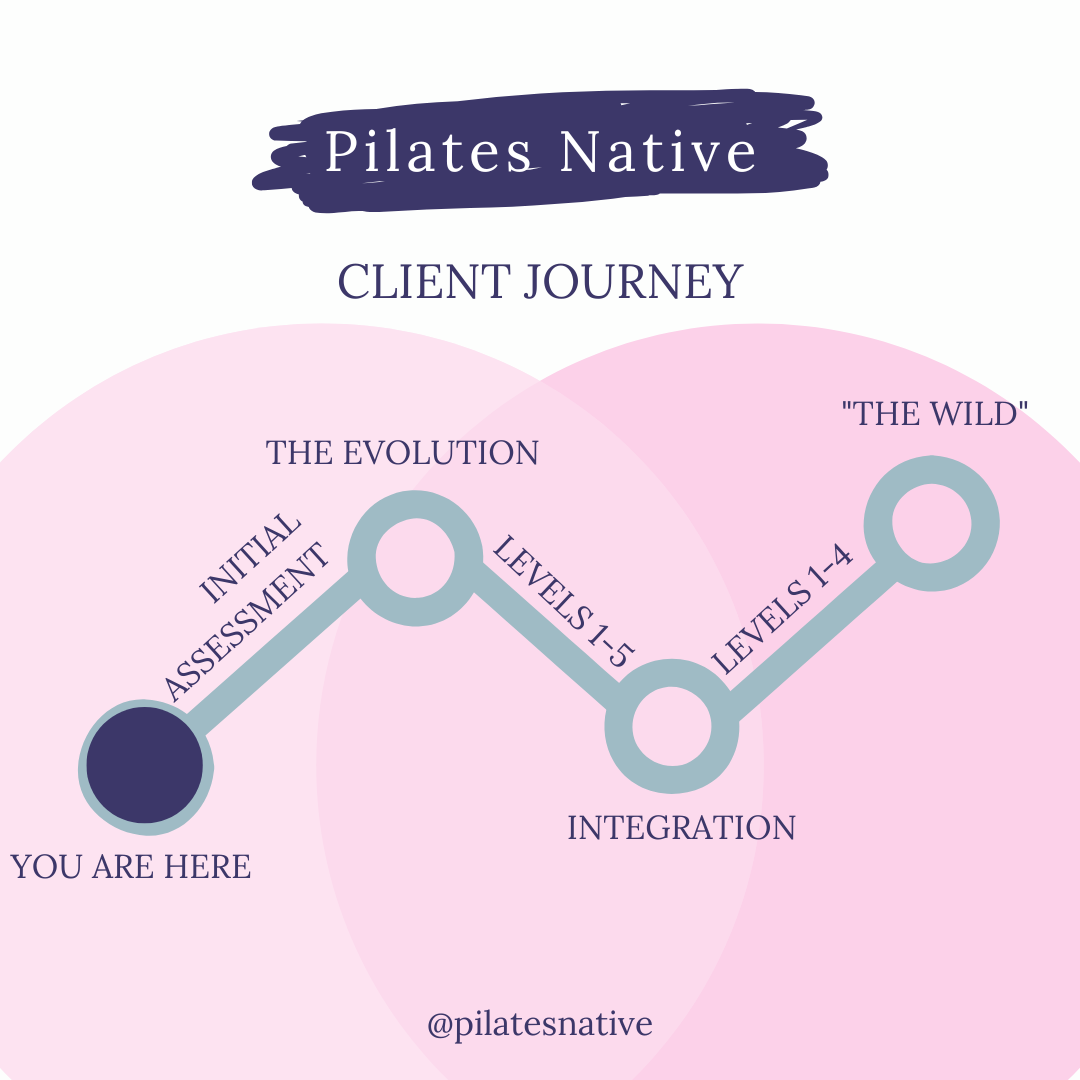
This prompted me to finally take all of the things that are in my brain and set them down on paper. So without further ado, I introduce you to “The Pilates Native Client Journey”.
You are Here
Pilates Native specializes in athletes and sports injuries. The majority of our clients identify with most or all of the description shown in the “You are Here” graphic. The aches, pains and irritation are what prompt folks to schedule their Initial Assessment (IA) with Pilates Native.
The Initial Assessment tells us where the body is in terms of balance, proprioception, core strength and functional mobility. Then, based on the results of the IA, we determine which program will work best for you: The Recovery Lab, The Balance Equation or the Stretch Equation.
The 1st two landmarks on the Client Journey map may be pretty familiar, as most of you have done your assessment and chosen a program. But what you’re not familiar with and what I’ve finally locked down onto paper, is the overall plan behind those assessments and programs and where we’re going with all of this!
The Evolution
There are 3 stages at Pilates Native: The Evolution, Integration and “The Wild”.
The first stage, called “The Evolution” focuses on really building and repairing the foundation of movement. This is where we focus on balance, proprioception, stability, core strength, and functional mobility. We know that these five foundational components are crucial to pain-free activity.
This stage includes The Recovery Lab, The Balance Equation and The Stretch Equation.
Why is it called “The Evolution”? Because we are evolving away from the mindset that movement and exercise is just for weight loss or ass kickin’ and can actually be used to heal the body. The Evolution has 5 levels, each with an increasing degree of balance, proprioception, core strength, stability, and functional mobility required.
Integration
Graduates of The Evolution move to Integration. Comprised of 4 levels, Integration is designed to build up the skills developed during The Evolution with the added challenge of integrating dynamic movement and endurance to the movement practice. Adding dynamic movement and endurance to our practice enables us to train in a way that supports positive muscle memory and promotes injury prevention.
This stage includes Integration and The Stretch Equation.
Why is it called “Integration”? Because we are actively integrating the tools learned in The Evolution with dynamic movement, endurance, and our specific daily life needs.
You may find yourself accidentally adding Pilates exercises to your workout routines, breathing deeply at the grocery store, or otherwise integrating what you’ve learned into daily life.
“The Wild”
And finally, The Wild! Graduates of Integration move into “The Wild” which is an advanced Pilates practice that explores and pushes the edges of what the body can do in an optimized state of mind + body connection and a functional balance between strength and mobility.
This stage includes Advanced Pilates and The Stretch Equation.
How long does this all take?
Where you are and how long it takes you to move through each level and each stage depends on you, your goals and your current abilities. There is no set timeline for these levels or stages, as each of us is different and may need more or less time to work through the program. Some of us may be fine staying in The Evolution or hanging out in Integration, and that’s totally ok! My goal as an Instructor is to get all of my clients through Integration. This is where you’re really thriving and able to perform your normal daily activities within the full range of functional movement.
You may have noticed that The Stretch Equation is included in each level. That’s because we want to support our mobility and nervous system needs at each stage. We also know that certain sports and activities create specific muscle patterns. Pairing stretch therapy with our Pilates practice allows us to maintain our functional balance between strength and mobility.
If it’s been 6 months or more since you’ve done your Initial Assessment, let’s check back in and see where you’re at now. We really want to use those assessments to guide your practice and make sure we’re focused where you need it most.
If you’ve never been in before and would like to get started, we’d love to have you! Come on in and let’s see what we can do.
Pilates vs The World
Posted originally on August 23, 2024 by pilatesnative
Trends in the fitness world move as quickly as fast fashion. Prancercising, hula hooping, kangaroo jumping, flash mobs, and pounding have all had their moment. Even the traditional fitness mainstays, running, strength training, cycling and swimming, have had their fads and fusions. Whether it’s Tabata, HIIT, CrossFit, barefoot running, treadmill dancing, parkour, or aqua cycling, there’s always something new and exciting breaking through and taking over. My least favorite has been the “hot” everything trend. Hot yoga, hot Pilates, hot Barre, hot weight lifting. Ugh.
Within the Pilates community, the traditional mainstays have been Classical Pilates and Contemporary Pilates.
But like all of the other movement modalities, Pilates has not been immune to trends or fusions. PiYo, also know as Yogalates, is a fusion of Piates + Yoga. Piloxing pairs Pilates with boxing. Legree uses Mega Reformers in a method that is essentially athletic training on the Pilates equipment w/o the Pilates method. Aerial Pilates, Pilates HIIT and probably a million more that I’m missing have all made their way into the Pilates sphere.
With so many fads competing for attention, it’s common to pit different fitness modalities against each other, and even within the same modality, various approaches often battle for dominance.
HIIT vs Tabata. CrossFit vs traditional Strength Training. Trail running vs road running. Pilates vs Yoga. Pilates vs Barre. Pilates vs Strength Training. Pilates vs HIIT. Classical Pilates vs Contemporary Pilates.
Social media is rife with debates about which workout is superior, creating a competitive atmosphere that can be confusing and sometimes dangerous, as influencers share more and more extreme versions of their routines to gain followers.
But what if we shifted the narrative from competition between modalities to collaboration?
My personal movement practice includes running, strength training, mountain biking, paddleboarding, ballroom dancing and Pilates, with running being my first, favorite and primary exercise type.
But I couldn’t run with out Pilates.
Before Pilates, I was running injured 90% of the time, seeing a chiro weekly and living through a cycle of injury->recover->injury->recover-> repeat. Pilates has helped me run 3-7 days/week for the last 15 years.
Without Pilates, I wouldn’t have the core strength, mobility or knee tracking needed for strength training. I wouldn’t have the confidence to attempt the balance exercises or new things that Josh, my trainer, throws my way.
Pilates frequently gets me through ballroom exercises, has helped on high ropes courses, allows me to stand confidently on the paddleboard, ensures my back doesn’t hurt after 6 hours of bagging 14’ers.
For me, Pilates isn’t my life, it’s the key to my life.
So why pit it against other modalities?
Instead of “Pilates vs”, why not “Pilates and….”.
Pilates vs and Strength Training
Strength training is essential for building muscle mass, boosting metabolism, and improving bone density. Whether you’re lifting weights, using resistance bands or body weight, strength training builds strength and hypertrophy.
If not done properly, traditional strength training can sometimes lead to muscle imbalances, reduced flexibility, and overtraining or injuries.
*Cue Pilates.
Pilates, with its focus on functional strength, deep core strength and stability, is a powerful complement to strength training. Pilates exercises not only enhance core strength and improves stability, it also promotes better posture, brain+body connection, alignment and mobility, all requirements of a good strength training practice.
Increased core strength through a Pilates practice can actually make strength training exercises more effective, as a strong core supports heavier lifts and more complex movements. Additionally, the emphasis on controlled, precise movements in Pilates helps to reduce the risk of injury by improving muscle coordination and balance.
Incorporating Pilates to a strength training practice can help address muscle imbalances, improve flexibility, and enhance overall movement efficiency. On the flip side, the muscle gains from strength training can support and enhance Pilates practice, allowing for more advanced movements and better endurance.
Pilates vs and Yoga
When they’re not being fused together in creative ways like PiYo, Pilates and yoga are often pitted against one another as mortal movement enemies. (ok that’s dramatic, but you get the idea.)
The truth is that Pilates and yoga have a lot of similarities and complement each other really well. Both practices emphasize breath control, flexibility, mindfulness and the mind-body connection.
Where they differ is in their original purpose and intent of practice. Yoga includes a spiritual aspect rooted in a religious tradition that’s over 2000 years old. Yoga classes incorporate meditation, internal awareness and spirituality to encourage relaxation, stress relief, alignment and spiritual health. While yoga can be a great tool for mobility, it’s primary focus has always been on the spirit. The original yogis practiced yoga as a way to prepare their bodies for hours of deep meditation.
Pilates, on the other hand, a relative baby at 100 years old, has always been much more focused on the physical body. Core strength, stability, focus, precision of movement, proper alignment and correct body mechanics. While you may experience relaxation or spiritual growth in a Pilates practice, it’s an added bonus, rather than the main focus.
For folks who primarily practice yoga, incorporating Pilates can provide strength-building exercises that support and enhance their yoga practice, particularly when it comes to developing stability around the joints and preventing hypermobility or overuse injuries.
The core strength developed in Pilates can also help with balance and alignment in yoga postures, reducing the risk of injury and allowing for more advanced poses. Pilates also often includes gait training and a pulling component, which are frequently missing from a yoga practice.
Conversely, the stretching and relaxation techniques of yoga can complement Pilates by improving flexibility and mental focus, helping practitioners to execute Pilates movements with greater ease and control.
Pilates vs and Running
Running is a repetitive, high-impact activity that places significant stress on the joints, particularly the knees, hips, ankles and low back.
Pilates helps counterbalance the intensity of running by strengthening the core, improving posture, and increasing flexibility, all of which are crucial for efficient and injury-free running. The core stability developed through Pilates supports better alignment and reduces the risk of common running injuries like runner’s knee, IT band syndrome, Plantar Fasciitis and shin splints. Additionally, the focus on breath control in Pilates can improve a runner’s breathing technique, leading to better endurance and stamina during long runs.
The Pilates Jump Board can also help improve gait, landing, and endurance, making it an excellent training companion for runners.
Pilates vs and HIIT/Tabata
Like running, HIIT and Tabata are known for their intensity. That intensity can sometimes lead to muscle strain, fatigue, and injury, particularly if not balanced with recovery and proper technique. Once again, that leads us to Pilates.
With its emphasis on control, precision, and core strength, Pilates can provide the perfect counterbalance to the intensity of HIIT or Tabata. Using Pilates as a recovery workout can help alleviate muscle soreness, improve flexibility, improve joint stability, increase balance and promote control during quick bursts of movement.
A strong core and better alignment can lead to more efficient movement patterns, reducing the risk of injury and allowing for more intensity and power during HIIT and Tabata.
The Key to Better Movement: Pilates AND
Whether you lift, run, hike, yoga, dance, HIIT or cycle, Pilates can help you build deep core strength, enhance flexibility, improve stability and balance, develop better posture and alignment, promote better mechanics, master breathing and increase functional mobility.
The key is to approach it as a collaboration, rather than a competition.
Pilates and…
If you’re ready to start your Pilates collaboration and enjoy the benefits of a Pilates practice in your normal workout routine, we’re here to help! Give me a call, reply to this email or shoot me a text.
The Power of Correction Impulse
Posted on July 15, 2024 by pilatesnative
Hey there, what’s up, what’s going on, how are you?
Last night at dance lessons, I asked Caleb, my instructor, if he could recommend some you tube videos, social media accounts or websites that I could check out to learn more about the technique he was teaching. In a dramatic and hilarious fit that could only be thrown by a professional dancer, Caleb informed me that I could film him teaching the technique and then watch that. His main point was that he knew where the content he was providing came from and could vouch for the accuracy, something he couldn’t do with social media resources.
Fair point, Caleb. Fair point. Which brings us to today’s bugbear…
In the last few months, I’ve come across a shocking number of social media posts sharing incorrect, wrong, weird or downright dangerous Pilates content.
There seems to be a growing movement that normalizes falling off of the Pilates equipment. You may have seen the reel of an NFL star falling off of a reformer or come across a post of someone sharing their falling experience, in a way that makes it seem like it’s an every day normal occurrence, or even worse, a right of passage, in the Pilates world.
Spoiler alert- In the same way that falling off of a treadmill or a piece of equipment in the gym is rare, falling off of the Pilates equipment is not a normal every day occurrence.
At the same time, I’ve seen a number of tutorial reels showing how to set up specific equipment, in a way that is 100% wrong and dangerous. A video showing how to attach a jump board to the reformer had tons of views and engagements, but completely missed adding in the safety locks of the foot bar, which keeps that jump board stable and prevents it from snapping back out of position.
Turns out, sharing incorrect information actually creates a TON of engagement and is backed by science as a sure fire way to get folks to comment and share your content.
Scientifically speaking, the “correction impulse” or “correction reflex” is the innate desire humans have to correct wrong information. We have an almost insatiable need to correct misinformation and seek to share or find accurate information.
So while that post showing a pro athlete doing Pilates may get a few hundred likes and some comments, a post of a pro athlete falling off of the Pilates equipment garnered thousands of views and comments. The incorrect jump board tutorial video had tons of instructors commenting and engaging with the content, while a proper tutorial may have gone unnoticed.
You may have even noticed this trick with content creators using spelling errors, grammar errors or even the wrong name to boost engagement. A recent major equipment company posted a photo of a man doing Pilates and labeled it Christiano Ronaldo. Folks were quick to correct that is was in fact Lionel Messi. Turns out, it wasn’t either.
But that post had an insane amount of engagement, so what does it matter?
The “correction impulse” or “correction reflex” may drive engagement on social media, but accuracy and safety should always be the priority. As fitness professionals and enthusiasts, it’s crucial to be discerning about the content we consume and share. Relying on qualified instructors and reputable sources ensures that we are practicing and promoting Pilates in a way that truly benefits our bodies. Which means we also need those professionals to be discerning about what and how they’re sharing too.
So, the next time you come across a Pilates video or post, take a moment to consider Caleb’s advice and ask yourself , “can I trust this content and who can vouch for its accuracy?”.
The Intentional Pairing of Pilates and FST to Create “Corrective Experiences”
Posted on April 22, 2024 by pilatesnative
2024 Stretch to Win Case Study
My fitness and bodywork career started 14 years ago at a Sports Chiro clinic in Houston that specialized in sports injuries.
Every client who came to see me for Pilates or FST was either actively injured, recovering from an injury, or trying to prevent another injury. In addition to being in physical pain, these folks were frequently also in emotional pain and mental despair. Their pain and injuries took vibrant, healthy people and turned them into people who were desperate, angry, frustrated, and depressed.
My first truly deep understanding of just how injuries impacted our mental and emotional health came when I received an email from one of my client’s wives. This client had been an absolute bear to work with. He was an endurance cyclist who had herniated multiple disks. He was extremely cranky, short with his answers and shot daggers across the room with his glares. The first three sessions were typically grunts, as he barely spoke to me during our hour together. With each passing week, as his symptoms resolved, he became a little less cranky. He talked a little bit more. He started smiling, then laughing and it turned out he was an excellent conversationalist. I started looking forward to our sessions. When his prescribed number of Pilates and FST sessions were completed, he gave me a hug, thanked me, and walked out the door.
A week later, the email from his wife arrived. In one of the most heartfelt thank yous I have ever received, she explained that the injury had completely changed her husband’s personality. The incredibly happy go lucky man she’d married had turned into an asshole. He was always angry, always in pain. Their marriage was on the rocks, they’d been seriously considering divorce and had already met with a lawyer. When he started Pilates and FST, he was a little less grumpy at the end of the day. A little bit sweeter, a little bit more like himself. She’d waited, watching week by week as his symptoms unraveled the stranglehold they’d had on his mental and emotional health. As his symptoms resolved, his personality returned. They were able to work on their marriage and started to resolve the issues his behavior had created. Her email was a sincere thankyou for saving their marriage.
With that email, I knew I’d found my life’s calling; helping injured athletes heal their bodies by also supporting their mental and emotional health.
When Mr. Hill walked into my studio two years ago, he reminded me a lot of that client years ago. He was a strong, fit, healthy man in the prime of his life. He was also in debilitating pain that left him afraid to sit, to reach, to do any motion that would take his horrible-but-manageable-pain and turn into the excruciating-not-manageable type of pain.
A lifelong outdoor enthusiast, Mr. Hill was a rock climber, mountain biker, snowboarder, and hiker. The kind who went higher, harder, faster, further. The kind who jumped things, flew through the air and took fear as a personal challenge.
While previous neck and shoulder injuries had checked his activities before, a back injury brought all those adventures to a screeching halt.
The man in front of me hadn’t been on a bike or a board in months and was hiking desperately on his good days to get as much movement as he could before the pain took over. His days consisted of a constant mental chess game, calculating which moves were safe, which could be slightly altered to feel ok right now-with pain management planned for later, which activities were removed completely from the board, which activities would be traded for the others he really wanted to do. The mental and emotional exhaustion was palpable, as each session often started with a deep resounding sigh in response to “how’s it going?”
While Mr. Hill was doing his best to avoid surgery, we both knew it was on the table. In addition to seeing me for Pilates and FST, Mr. Hill was also treating his back pain with chiropractic, acupuncture, massage, PT, meditation, and therapy.
When working with Mr. Hill, I knew we had to work on mental and emotional safety around movement before tackling the traditional fitness concerns of stability, strength, and flexibility. Without safety, progress would be impossible.
We started with a functional core strength and range of motion test, with Mr. Hill moving his own body into various ranges of motion. I noted which positions caused anxiety, fear, or were avoided completely. Next, I used an FST session to assess his passive range of motion, this time noting any guarding and whether the available range matched the guarding or fear response in the ranges previously noted.
After seeing where Mr. Hill was able to move and how he reacted to certain positions, I created an FST and Pilates plan that kept him well within the areas where he felt comfortable, but focused on creating stability, strength, and mobility around the area of injury.
By stabilizing and strengthening around the injury, while also gently increasing mobility, we were able to create some relief in the pain points, while also building confidence and security in those ranges. Each week, we used FST to find and assess where those edges and boundaries were, downregulate the nervous system, improve range of motion and mobility, and teach the body new patterns.
Throughout our sessions together, there were excellent days where pain was minimal, strength and mobility were maximal. There were also days when pain was maximal, and our focus was really on managing the flare and moving in ways that felt good and provided relief.
While Pilates and FST weren’t the magic bullet we’d been hoping for, they did provide some relief as well as a strong pre-surgery foundation. After a series of disappointing nerve ablations, Mr. Hill opted for L5-S1 fusion, which was successful.
After surgery, Mr. Hill had much more available range of motion and we were able to focus even more in depth on recovering strength, mobility and range of motion that had been lost due to the original injury, as well as post-surgery recovery. We also continue to work on what Mr. Hill calls “corrective experiences”, a term borrowed from the book “The Way Out” by Alan Gordon. Corrective experiences are successfully performing activities or movements, pain-free, that we typically avoid because we’re afraid they’ll cause pain.
By using Pilates and FST in an intentional way, we were able to create entire sessions of “corrective experiences” for Mr. Hill, teaching the mind and body that the various movements and patterns are safe and do not cause pain or pain flares. FST allowed us to find his boundaries and work right up to them in a way that didn’t cause pain or flares.
I am extremely humbled by Mr. Hill’s trust and have greatly appreciated his willingness to experiment together as we “do weird shit in the name of science”.
Working with him has allowed me to really refine my skills as a practitioner and I have been able to apply the same principles of using Pilates and FST to develop corrective experiences for all my clients. Whether they come in with labral tears, frozen shoulders, herniated disks or sciatica, the results have been absolutely astounding.
Applying FST to my Pilates sessions has given me a deeper understanding of and connection to my clients. I can assess them tactilely in a way that is safe and helpful to their nervous systems. FST also gives me the ability to teach their body new patterns in a way that is gentle and beneficial to their joint and muscular health.
As a long time Pilates Instructor, I’m very excited about the results and the pace we’re achieving them with the intentional pairing of Pilates and Stretch Therapy when dealing with chronic pain.
What I’ve found is that my clients aren’t just getting relief. They’re getting their lives back. From spending a day snowboarding confidently, joining a dance class they’d never even attempt before, learning how to do handstands, or even just lifting something into a grocery cart or loading a dishwasher without pain, the results have spoken for themselves. “Corrective Experiences” are where it’s at.
A giant heartfelt thanks goes out to each of my clients who have joined me in experimenting, playing and “doing weird shit in the name of science”.
Have a great day,
-Rubecca
p.s. As always, I LOVE to hear your thoughts on these posts. Feel free to reply to email or bring up this topic in your next session.
How I deal with a pain flare-up
Posted on March 26, 2024 by pilatesnative
Hey there, happy March!
What a joyous thing to see so much more sun the last few weeks. I am so excited for the longer, warmer days. This newsletter comes to you fairly late in the month. March has been extremely dualistic, from long cold days and a month long pain flare-up of a decades old injury, to a wonderful family vacation, visiting my 49th state and beautiful warm sunny days.
The deep bone throb in my leg has accompanied (and unfortunately at times dampened) hanging out with my kiddo, spending time with my family and even fully enjoying our instructor trainees completing their Mat modules and diving into the equipment work. This nagging flare has interrupted my strength training schedule, negatively impacted my running and has even been rude enough to disrupt sleep. I’ve been cranky beyond belief. Even this newsletter, one of my favorite admin tasks, is low effort and lacking this month.
Sound familiar?
Like many of you, I came to Pilates through extreme chronic pain and injury.
In my early 20’s, my body was extremely worn out and ragged from a really terrible relationship with fitness that frequently left my body very damaged. Limping, bracing, sleeping with heating pads, smelling like Tiger Balm, and taking Ibuprofen on a regular schedule was normal. I had a standing weekly appointment with the chiropractor and frequently chose shoes based on which pair minimized pain. At 25, I, along with the 65 year old men in my department, had a prescription for a standing desk and midday walk breaks to help with pain management. Road trips, flights, concerts, my car, even dinner plans were made around pain.
When my doctor prescribed Pilates, I was skeptical and certain that my lifestyle choices meant just dealing with a life of constant irritation, aches and pains.
At the time, I just didn’t know any different.
It’s been a long time since that first Mat Pilates class, which left me shaking and unable to perform 75% of the class.
Pilates has been a constant companion for the last 16 years, through injury recovery, pregnancy, postnatal recovery, moving cross country, changing careers twice, surgery, and a whole lot of major life moments.
With this latest pain flare-up of an extremely old injury that I was certain was managed, I’ve felt betrayed by both my body and by my Pilates practice. Between feeling angry, frustrated and disappointed, I have managed a few moments of clear reflection.
And the truth is, that I just haven’t been doing my own work…for months.
At some point, without reason or me noticing, I just stopped doing any sort of recovery or restoration work. Stopped warming up or cooling down for runs. Stopped stretching. Stopped meditating. Stopped my Pilates practice. Stopped managing my food allergies. Stopped all Stretch Therapy, Chiro, Rolfing and Massage. At the same time, I maintained my weekly running sessions, tripled my strength training sessions and doubled my dance lessons.
This, in my professional opinion, has been a recipe for disaster.
As my low back and left leg will attest, disaster has struck.
So what now? After a good long pity party, I’ve spent the last few weeks using aaaallll of the tools I’ve learned over the last 16 years, including tapping into a team of experts to help me recalibrate. Recovery has looked like:
Immediately eliminating all food allergens and working with Tina, a trusted friend and nutritionist to get me back to normal.
Meditating again, and actively working on recognizing when I am in a mental pain spiral and separating that from an actual physical pain cycle. The book The Way Out, recommend by a client, has been a invaluable resource this month.
Unrolling my mat for a weekly movement and soul practice at Urban Sanctuary.
Adding the required PT exercises to my strength training routine, backing down to twice a week and getting back on schedule with my trainer, Josh.
Booking appointments with my friend Britni for PT and my favorite chiro, Britni at Denver Sports Medicine.
Dusting off the trusty old reformer and rekindling the love affair with Pilates that started 16 years ago.
I’ve always described my Pilates and recovery work as the toothbrushing of my movement practice. It’s not sexy, or entertaining, or overly exciting. But man, is it effective.
If you’ve been experiencing a similar pain cycle or set back, I see you. It sucks. But with consistency and intention, we can get back on track.
See you very soon!
-Rubecca
p.s. if you’d like to book a session with me, you can do that here.